
From Learning to Earning: Why 1TO1 TL Ltd’s Education Programmes Respond to Real Learning Needs in Rwanda
Education access in Rwanda has expanded considerably, but national data also shows that important gaps remain in early childhood education, foundational learning, adult literacy and digital skills. These gaps help explain why education services increasingly need to go beyond conventional classroom teaching and provide practical support to children, school learners, adults, teachers and families.
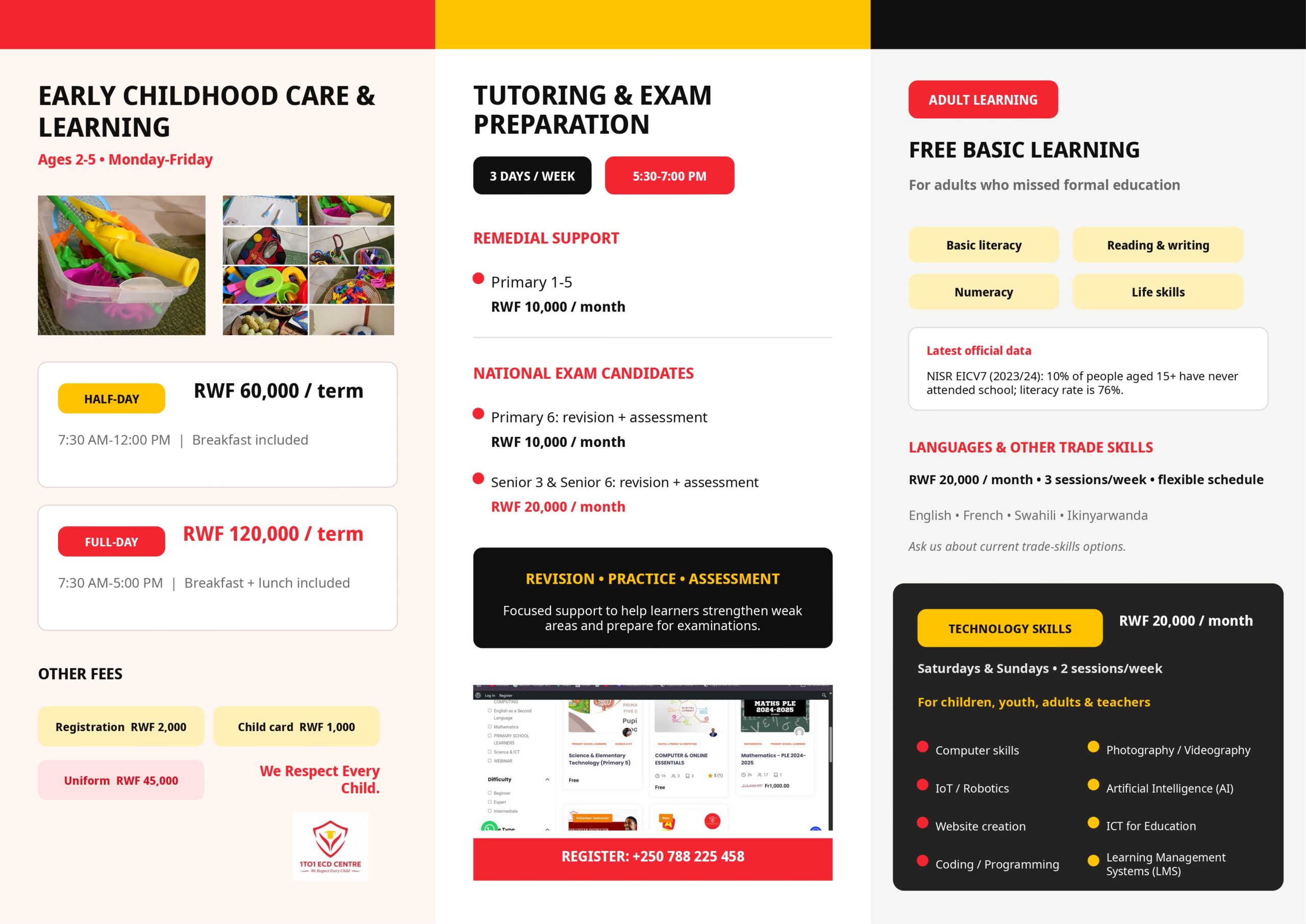
1TO1 TEACHING LEARNING Ltd is developing such an approach through four connected areas: Early Childhood Education, Tutoring and Examination Preparation, Adult Learning, and Technology Skills. The company’s wider model also includes online courses, mock assessments, robotics and STEM activities, and locally developed learning materials.
The idea behind the model is simple: learning needs occur at different stages of life, so educational support should not stop at one age, one subject or one type of learner.
Early childhood education: access is improving, but the gap remains large
Rwanda has made important progress in pre-primary education. According to the Ministry of Education’s 2024/2025 Education Statistical Yearbook, the net enrolment rate for children aged 3–5 increased from 44.7% in 2023/24 to 50.3% in 2024/25. mineduc.gov.rw
That improvement is encouraging, but it also means that roughly half of children in the official pre-primary age group are still outside age-appropriate pre-primary enrolment.
The same Ministry report recorded 1,268,604 children across ECD centres and pre-primary settings in 2024/25. It also reported a decline in children registered specifically in ECED centres, from 692,507 to 585,370 between 2023/24 and 2024/25. mineduc.gov.rw
This provides important context for the work of 1TO1 ECD CENTRE in Mbandazi, Rusororo. The centre serves children aged 2–5 and is designed around child-centred early care and learning under the principle “We Respect Every Child.” Its current programme provides both half-day and full-day options.
Early childhood education is therefore not simply an additional service. It responds to a national priority where access has improved rapidly but remains incomplete.
School attendance is high at primary level, but progression remains a challenge
Rwanda has achieved very strong participation at primary-school level. The Ministry of Education reports a 95.8% primary net enrolment rate in 2024/25. However, secondary net enrolment stood at only 28.9%. mineduc.gov.rw
Household data tells a similar story. The National Institute of Statistics of Rwanda’s EICV7 education report found a 92.8% primary net attendance rate, while secondary net attendance was only 33.7%. It also found that 21% of children who attended primary school in 2022/23 repeated the same grade in 2023/24. statistics.gov.rw
These figures show why education cannot be measured only by whether a learner is enrolled. Learners also need to understand what they are taught, address weaknesses early and successfully progress through the system.
This is the need behind 1TO1 Tutoring and Examination Preparation.
The programme includes remedial support for Primary 1–5 and structured revision and assessment for national examination classes including P6, S3 and S6. The approach emphasises revision, practice and assessment, rather than simply adding more classroom hours.
For learners who have difficulty in particular areas, timely additional support can help address gaps before those gaps become barriers to later learning.
Adult learning remains necessary
Education also cannot stop with school-age learners.
EICV7 found that 10% of Rwandans aged 15 and above had never attended school, while another 41% had attended school but had not completed primary education. Only 49% had completed at least primary education. statistics.gov.rw
The same national survey placed adult literacy among people aged 15 and above at 76%. Kigali recorded the highest rate, at 91%, but the national figure still means that a significant part of the adult population lacks basic literacy. statistics.gov.rw
Adult-learning infrastructure also faces pressure. Rwanda had 4,829 adult literacy centres in 2024/25, down from 4,991 the previous year. Adult literacy enrolment declined from 99,255 to 93,548 learners, a reduction of 5.7%. mineduc.gov.rw
1TO1 therefore separates its Adult Learning programme into two important areas.
Basic learning is offered for adults who missed formal education, covering literacy, reading and writing, numeracy and life skills. Separately, learners can enrol in paid language and other skills programmes, including English, French, Swahili and Ikinyarwanda.
That distinction matters. Adult education is not simply language training; for some learners, it begins with gaining foundational skills that many people acquired through formal schooling.
Rwanda’s digital transformation also requires digital skills
One of the strongest arguments for practical technology training comes directly from Rwanda’s education and household data.
EICV7 found national computer literacy of only 12.8% among the population covered by the indicator. The urban rate was 27.5%, compared with only 6.6% in rural areas. Kigali had the country’s highest provincial computer-literacy rate at 32%. statistics.gov.rw
This means that even in Kigali, where access and literacy are considerably higher than the national average, practical computer capability cannot be assumed.
Schools are also still developing their use of technology. Ministry of Education data shows that 40.8% of schools used ICT for teaching and learning in 2024/25. At primary level, the figure was 40.6%, while it was 38.6% at pre-primary level and 55.5% in general and professional secondary schools. mineduc.gov.rw
The Ministry specifically identifies both ICT infrastructure and teacher training in ICT-integrated teaching and learning as areas requiring continued attention. mineduc.gov.rw
This strongly supports the role of programmes that teach technology through practical use rather than theory alone.
Under 1TO1 Technology Skills, learners can access areas including computer skills, coding and programming, IoT and robotics, artificial intelligence, website creation, photography and videography, ICT for education and learning-management systems. The programme is intended for children, young people, adults and teachers.
The wider 1TO1 model also incorporates robotics and STEM activities for young learners, online courses and practical learning materials.
Why teachers matter in technology education
Technology equipment by itself does not create meaningful learning. Teachers need the confidence and practical ability to use it.
Rwanda’s Education Sector Strategic Plan 2024–2029 identifies the distribution of computers, e-learning, teacher ICT certification and teacher development in digital literacy among national priorities. mineduc.gov.rw
The World Bank has likewise recommended strengthening Rwanda’s digital-skills framework, improving instructor training and expanding access to affordable digital tools as part of the country’s skills-development agenda. World Bank
This is the thinking behind 1TO1’s IoT & Robotics for Teachers initiative.
The programme introduces teachers to tools such as Scratch, mBlock, VEXcode VR, Tinkercad Circuits and Arduino IDE and connects screen-based coding to real physical computing. Planned practical activities include an obstacle-avoidance robot, smart electronic-kit projects and a traffic-light electronics project.
Instead of asking teachers only to listen to presentations about technology, the programme is designed around building, testing, troubleshooting and considering how those activities can later be adapted for classrooms and school clubs.
One education ecosystem rather than isolated programmes
What connects these programmes is the idea that learning challenges are related.
A child who receives quality early learning needs continued support through primary school. A learner preparing for an examination may also need digital skills. A teacher introducing robotics needs practical professional development. An adult who missed formal schooling may begin with basic literacy before progressing to languages, technology or vocational skills.
That is why 1TO1 TL Ltd describes its model as:
“From Learning to Earning.”
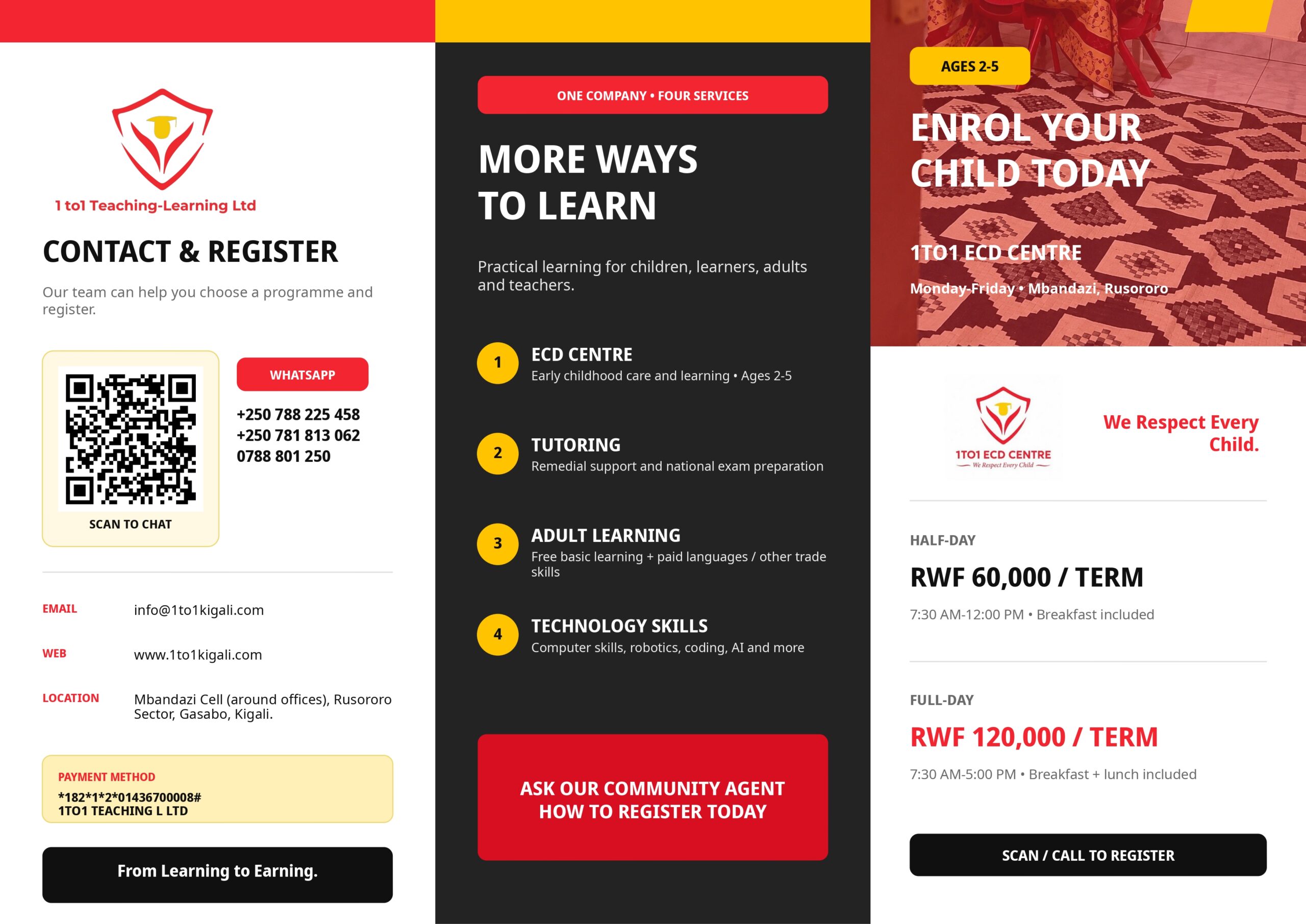
Its current public programme structure brings together four main services:
ECD Centre — early childhood care and learning.
Tutoring — remedial learning and national examination preparation.
Adult Learning — foundational literacy alongside languages and other skills.
Technology Skills — computer skills, coding, robotics, AI and other practical digital competencies.
The model is aligned with a wider national reality: Rwanda has achieved major improvements in educational access, yet data continues to reveal gaps in early learning participation, school progression, adult literacy and digital competence.
Addressing those challenges requires government, schools, families, educators, civil-society organisations and private education providers to contribute in complementary ways.
For 1TO1 TEACHING LEARNING Ltd, the aim is to contribute through accessible, practical learning opportunities that can accompany people from their earliest years of education through school, adulthood, professional development and technology skills.
From Learning to Earning.
For programme information and registration:
1TO1 TEACHING LEARNING Ltd
Mbandazi Cell, Rusororo Sector, Gasabo, Kigali
WhatsApp: +250 788 225 458 / +250 781 813 062/+250788801250
Email: info@1to1kigali.com
Website: www.1to1kigali.com
Good post.Thanks to CTO!
It’s a pleasure sir!